
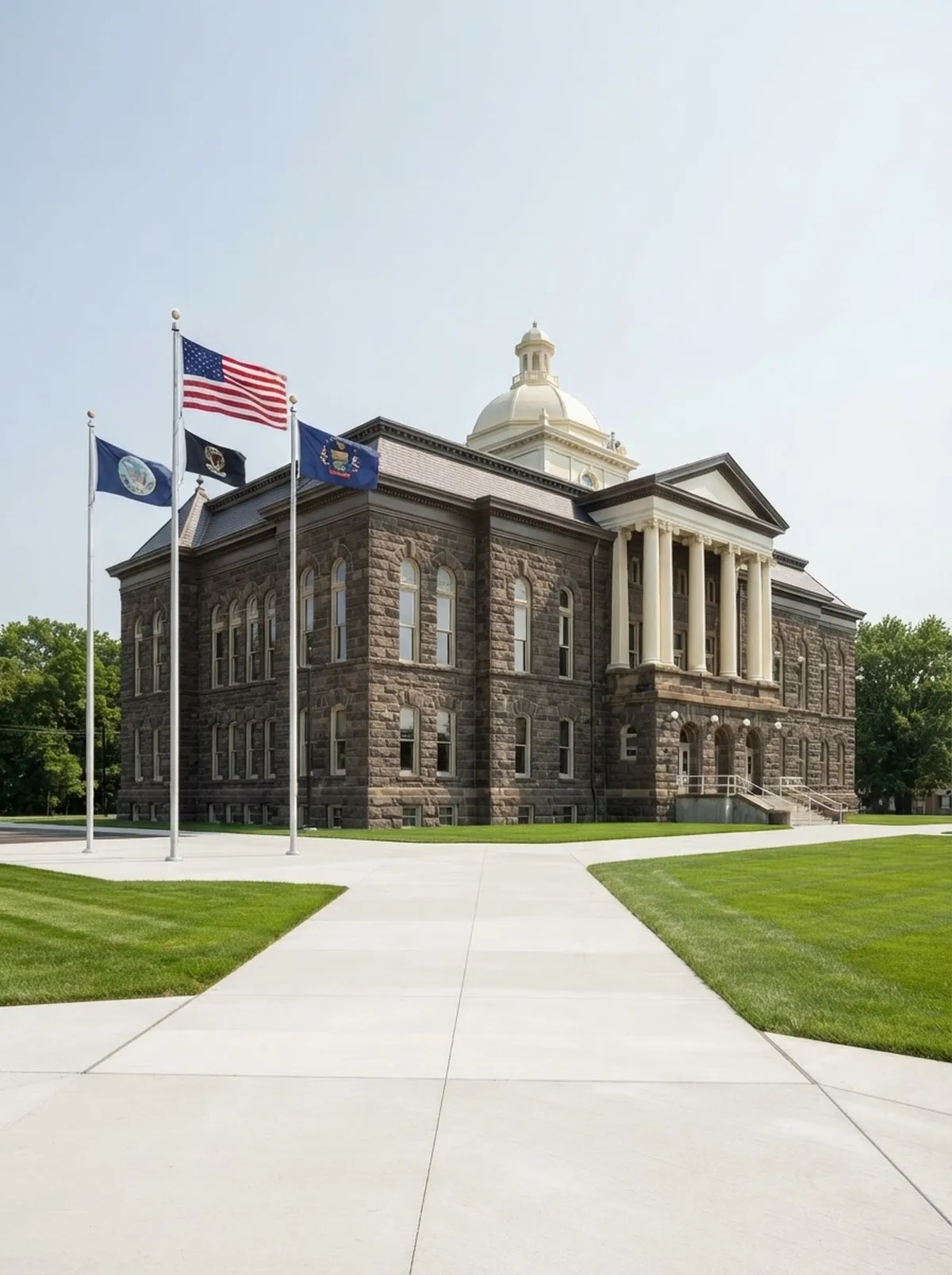
Niagara County court records in New York are maintained by the County Clerk and are accessible through online tools, official court portals, and directly at the Clerk's office. NiagaraCourt.us is a convenient resource to start searching for publicly available court record information. Additionally, you can use the Niagara County Clerk's portal, the NYSCEF electronic filing system, and other New York State government databases.
Niagara Court System Overview
Niagara County is located in the northwestern corner of New York State and is part of the 8th Judicial District. This judicial district also includes Allegany, Cattaraugus, Chautauqua, Erie, Genesee, Orleans, and Wyoming counties. The primary court of general jurisdiction is the Niagara County Supreme Court, which hears civil and criminal cases without monetary or severity limitations. The County Court handles criminal felonies and civil cases with limited jurisdiction. The courthouse is located at:
The Clerk's office hours are typically Monday through Friday, from 9:00 AM to 5:00 PM. For the current schedule, please contact the Clerk's office.
Courts Serving Niagara
Residents of the county are served by several courts at different jurisdictional levels.
State Courts
Niagara County Supreme Court & County Court
Niagara County Surrogate's Court
Niagara County Family Court
City Courts
Lockport City Court
Niagara Falls City Court
North Tonawanda City Court
Federal Court
U.S. District Court, Western District of New York
Niagara County falls under the jurisdiction of the Western District of New York. Bankruptcy cases are handled by the U.S. Bankruptcy Court for the same district at the same address in Buffalo.
Additionally, many towns and villages have Town and Village Courts that handle minor offenses and traffic violations at the local level.
What Types of Cases Niagara Courts Hear
Niagara County courts hear a wide range of cases:
- Criminal felonies and misdemeanors
- Minor offenses (infractions), including traffic violations
- Civil claims of varying complexity, including small claims
- Family law: divorce, custody, child support
- Probate and guardianship cases
- Juvenile and child protection cases
- Adoptions
- DUI/DWI
District Court Cases in Niagara
In the New York State system, the County Court performs the functions of a "district court" in the classical sense. This court handles criminal felonies that arise after an indictment by a grand jury or after a case is transferred from a lower court. Civil cases with claims up to $25,000 also fall here.
The Supreme Court, on the other hand, has unlimited jurisdiction. It handles complex civil disputes, divorce cases, and large claims. Cases are distributed among judges according to the court's internal procedures. Appeals from the County Court and lower courts are directed to the Appellate Division, Fourth Department.
Magistrate Court Cases in Niagara
In New York State, City Courts, Town Courts, and Village Courts perform the role of magistrate courts. They have jurisdiction over:
- Misdemeanors and minor offenses
- Preliminary hearings in felony cases
- Traffic violations
- DWI cases — from charging to hearings
- Civil claims up to $15,000 (in City Courts)
- Small claims up to $5,000
Town and Village Courts handle cases arising within their territory. If the case volume is large — for example, in Niagara Falls City Court — individual judges may specialize in certain categories.
Family Law, Probate, and Juvenile Matters in Niagara
Family Law
Niagara County Family Court handles cases related to child custody, support, protective orders, paternity establishment, and termination of parental rights. Divorces are processed through the Supreme Court, as only this court has the authority to dissolve marriages under state law.
Probate Cases
Surrogate's Court is responsible for the estates of deceased persons, probate of wills, appointment of guardians and estate administrators. This court also handles trust cases.
Juvenile Matters
Family Court conducts proceedings related to juvenile delinquency and child protective proceedings. Juvenile case records are confidential. The Niagara County Probation Department provides pretrial services, including for individuals involved in criminal proceedings.
How Cases Move Through the Niagara Court System
- Case Initiation. A criminal case begins with a complaint or indictment. A civil case starts with the filing of a complaint. Family or probate cases begin with a petition.
- Judge Assignment. The case is assigned to a judge according to the court's internal rules.
- Initial Hearings. In criminal cases — arraignment (charging and bail determination). In civil cases — a preliminary conference to set the schedule.
- Pretrial Phase. Parties exchange evidence (discovery), file motions. In criminal cases, plea bargaining is possible.
- Trial or Resolution. The case concludes with a jury or judge's verdict, settlement, guilty plea, or default judgment.
- Post-Judgment. Sentencing, appeal filing, enforcement of the court's decision.
Electronic filing (e-filing) is mandatory in most case categories in Niagara County — through the NYSCEF system.
Court Administration, Local Rules, and Public Access in Niagara
The courts of the 8th Judicial District are under the administrative leadership of the Administrative Judge, appointed by the Chief Administrative Judge of New York State. Local court rules for this district are published on the New York State Unified Court System website.
Under state law, most court records are public. Exceptions include juvenile cases, sealed criminal records, and certain family cases. Information on sealing criminal records is provided by the state Attorney General's office.
To obtain public records, contact the County Clerk's office:
Hearings are generally open to the public. For participation in remote sessions, check the procedure with the specific court's office — some courts offer video or telephone access.
Court Records and Related Court Resources in Niagara
- Court Case Search and e-filing: Electronic filing and case viewing are available through the NYSCEF portal. Select Niagara County from the dropdown menu on the County Clerk's page.
- Land Records and Document Registration: The County Clerk's office also maintains a real estate registry. Information on property assessment and taxes is provided by the Real Property Tax Services department.
- Criminal History Check: State residents can request their own criminal record through NY DCJS. General information on criminal statistics and the sex offender registry is provided by the Division of Criminal Justice Services.
- Inmate Lookup: To check the status of a person in state correctional facilities, use the Incarcerated Lookup from NY DOCCS.
- Arrest Warrants: A list of individuals wanted on probation warrants is published by the Niagara County Probation Department. The state police maintain a separate list of wanted persons.
- Tax Warrants: Open tax warrants statewide can be checked through the NYS Tax Warrants search tool.
- Law Enforcement Contacts: A list of county police departments is available on the District Attorney's page.
- County Treasury: Questions about unpaid taxes and financial obligations are handled by the County Treasurer's office.
For a general search of public court information in Niagara County, also use NiagaraCourt.us.